Scoot TR11 B787-8 Economy Review — Sydney to Singapore 2026

The last time I flew Scoot was when they launched in Australia in 2012. I vowed I wouldn’t do it again. Then a return fare to Singapore came up for $400 and it would have been impolite to refuse. This was a spontaneous escape driven entirely by price.
Four hundred dollars return. Sydney to Singapore. Eight and a half hours each way. You do the maths and then you book before you talk yourself out of it.
We caught the bus from Mascot station to avoid the station access fee — currently $17.92 just to enter Sydney Airport by train. That money was better spent in Singapore. As hand luggage only passengers we went straight to the Scoot check-in kiosks, cleared immigration in ten minutes flat, and headed to the Plaza Premium Lounge for two hours before the gate. From bus to airside: a personal best.
Booking
The Scoot website is straightforward. They will try to upsell you at every step — bags, meals, seat selection, travel insurance — but if you know what you want (nothing) it’s easy enough to decline everything and get out quickly. We travelled with 10kg bags and had 4kg to spare, which tells you something about the art of packing light.
Four days before departure, Scoot offered us the chance to bid for an upgrade to Scoot Biz. It’s an 8.5 hour flight but I can do Singapore Airlines economy easily, so comfort wasn’t the concern — it was more that I liked the idea of sitting in business class eating my own curried eggs. We put in the minimum bid plus three dollars.
That strategy did not work.
Check-in and boarding
This was the genuinely impressive part. Scoot offers “Scoot to Gate” for hand luggage only travellers — essentially a message telling you to skip the check-in queue entirely and go straight to immigration. We received it online and did exactly that. Ten minutes from the bus stop to airside. I’ve spent longer waiting for a coffee.
We arrived three hours before departure out of habit. With Scoot to Gate the honest answer is 45 minutes would have been enough. I wouldn’t recommend cutting it that fine — that’s the kind of thing that works until it doesn’t — but 90 minutes is comfortably achievable.
Boarding itself was delayed 30 minutes but Scoot’s ground crew are efficient. The welcome message started at 1pm on time. We didn’t push back from the gate until 1:07. A full plane, loaded and moving in 22 minutes.
One unexpected bonus of being at the back: we boarded early. Scoot fills the plane from the rear, so after the priority passengers came rows 40 and above — which meant we were on before the bulk of the cabin and had the overhead bins completely to ourselves.
The seat — why rows 40 and 41 are the right answer
We were in seats 40A and 40C. I need to make a case for this because most people run from the back of the plane and they are wrong.
Here’s what happens at row 40 on this aircraft: the cabin configuration changes from 3-abreast to 2-abreast on the window side. That means the seat beside you disappears. Not in front — beside you. For a couple travelling together, you have the entire 2-seat section to yourselves with nobody sharing your row.
Row 41 is similar and worth knowing about. The recline of the seat in front of 41 is less predictable — someone was sitting there but not next to us — but the layout still gives you that same massive gap between you and the window. We used it to dump bags, shoes, hats, lunch, and anything else that needed a home. On a full flight that extra real estate is worth more than you’d expect.
The seat itself is economy. If you’re tall, it’s tight. If you’re Julie, you’ll love it. The armrests go up and down, including the aisle one that isn’t supposed to. Recline exists but is modest. It’s a budget long-haul seat and it does what it says.
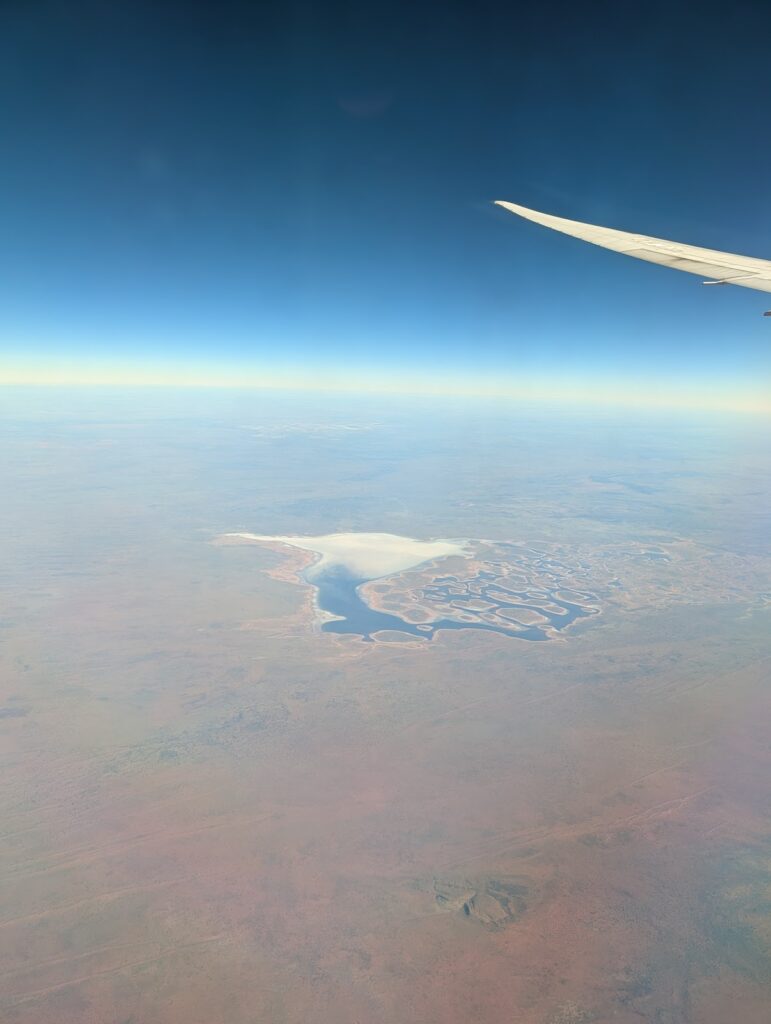
The view from row 40 is also better than mid-cabin. You’re behind the wing rather than level with it, which means you see under it rather than into the engine. Over central Australia after recent rain, the salt pans were full — vast pink and white expanses I could have watched for the entire flight.
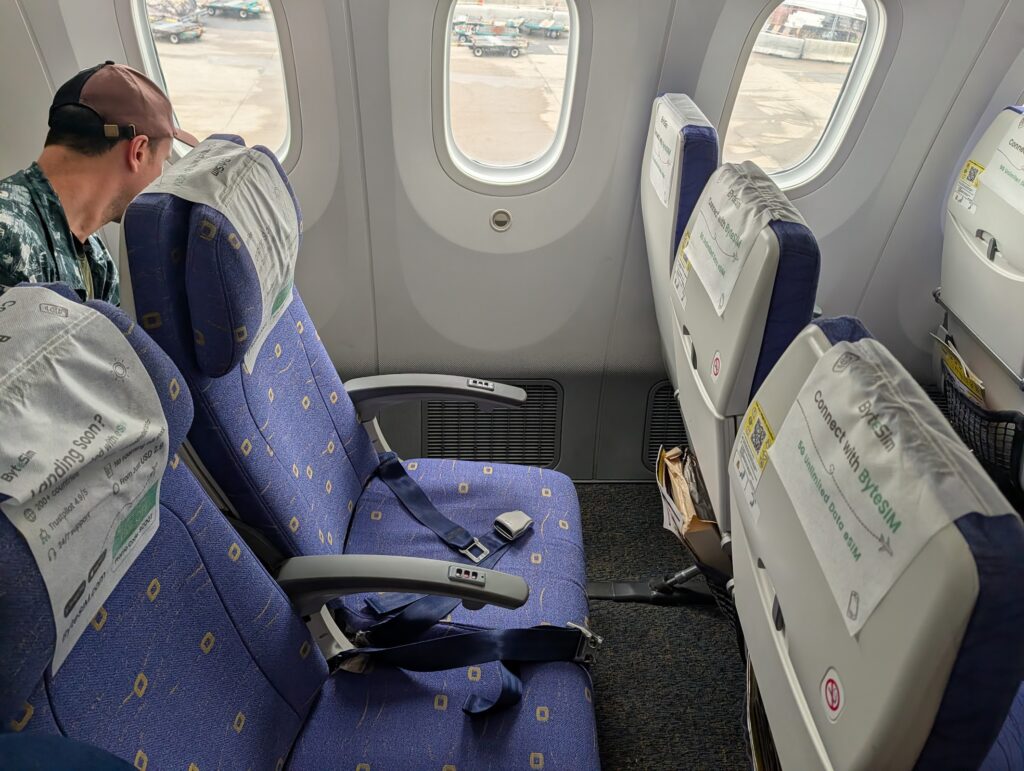
- The 3-to-2 seat configuration means the seat beside you is gone — it’s private space, not a shared row.
- For a couple, you have the entire 2-seat section to yourselves with no stranger alongside.
- The gap between you and the aisle is enormous — perfect for storing bags, shoes, and everything Julie brings.
- You board early — Scoot fills from the rear, so you’re on after priority and well before the main cabin.
- Under-wing view rather than into the engine — noticeably better over central Australia.
- Galley and toilets are nearby but stay quiet on a buy-on-board airline where few people are buying.
Food and drink
Scoot is buy-on-board. No food, no drinks included. The menu runs to cup noodles, chips, biscuits and soft drinks — all priced in SGD and in the affordable-but-unappealing range. Wine was available: SGD 18 for two 187ml bottles, which is acceptable by airport standards. I’d estimate fewer than 10% of passengers had pre-ordered food and maybe 30% bought something on board. Most people flying Scoot are doing it to save money, and spending it on a cup of noodles is counterproductive.
We brought our own. Curried egg on corn thins — yes, we were those people — plus fruit, dates, nuts, and water bottles filled at the Plaza Premium Lounge before we boarded. Between a big breakfast in the lounge and our own snacks we didn’t need to spend a dollar on food. For a daytime flight this is entirely manageable.
The staff — called Scootees, which I respect — ran two food service rounds. The first came through around the two-hour mark. At row 40, the second service didn’t reach us until 2.5 hours in, because they’re taking orders, processing payment and fulfilling them as they go. It’s slow by full-service standards but irrelevant if you’ve brought your own.
Crew
Young, polite and efficient. The Scootees handled a buy-on-board service on a full plane without making it feel chaotic, which takes more skill than it looks. They carried card readers for those who hadn’t pre-ordered and were also handling Singapore dollars and Australian cash. No complaints.
Entertainment and the long haul
There are no seatback screens. The B787-8 has a cabin dimmer that reduces the light level — it was dimmed around two hours and forty minutes in — but the lights stay on throughout and some passengers kept their window shades open regardless. If you want to sleep, bring an eye mask. Julie had one, plus a neck pillow, foot pillow and back pillow. She was organised. I raw dogged it.
Seven hours and twenty minutes was the announced flight time, which is about as much economy as you want to sit through. A daytime flight makes it easier — if you can organise your own entertainment the time moves. I worked through a backlog of podcasts: food in Singapore, world politics, NPR music, upcoming cruise vlogs. I wrote this post. I watched the salt pans. It was fine.
One legitimate downside: no moving map. On a full-service airline you always know where you are. On Scoot you’re guessing by looking out the window and calculating roughly how long you’ve been flying. For some people this will be annoying. I found it oddly peaceful.
- → Filled water bottle — saves you buying water on board for 8.5 hours.
- → Your own snacks — the on-board menu exists but you won’t want it.
- → Eye mask — the cabin doesn’t go fully dark and window shades stay open.
- → A comfortable fleece or layer — the cabin temperature is fine but sitting still cools you down.
- → Downloaded content on your phone — there are no seatback screens.
- → Headphones — noise cancelling if you have them, the engine noise at the back is present but manageable.
The verdict
A $200 Sydney to Singapore fare on a daytime B787-8 flight is a good deal. There is no version of this where it isn’t. The seat is economy, the food is buy-on-board, and there are no screens — but none of that is a surprise. Scoot tells you exactly what you’re getting.
The formula is simple: hand luggage only, daytime flight, row 40, your own snacks, downloaded content, and a bargain fare. If all of those line up — and for us they did — Scoot is a completely rational choice for the Sydney–Singapore route.
What I don’t yet know is how Scoot handles disruptions, missed connections, or irregular operations. We have a separate article on what happens when you miss a connection — worth reading before you book a tight itinerary on any budget carrier.
- ✓ You can travel hand luggage only and avoid the bag fees entirely.
- ✓ You’re booking a daytime flight and can manage your own entertainment.
- ✓ You’re flexible enough to take row 40 and make the most of the extra space.
- ✓ The fare is significantly cheaper than the full-service alternatives — which it usually is.
- ✕ You need a checked bag — the fees close the price gap with full-service carriers quickly.
- ✕ You’re booking a tight connection on the other end — disruption handling on budget carriers is a different experience.
- ✕ You need a moving map and seatback screen to feel comfortable on a long haul.
Our rating — TR11 SYD to SIN
| Seat comfort | ⭐⭐⭐ |
| Food & drink | ⭐⭐ (bring your own) |
| Crew | ⭐⭐⭐⭐ |
| Value for money | ⭐⭐⭐⭐⭐ |
| Punctuality | ⭐⭐⭐⭐ |
Frequently asked questions
What aircraft does Scoot fly on the Sydney to Singapore route? +
The outbound TR11 (Sydney to Singapore) uses a Boeing 787-8 Dreamliner. The return TR12 (Singapore to Sydney) operates on a B787-9, which is slightly longer. Both are wide-body jets with a reasonable cabin environment for economy.
How many Scoot flights operate between Sydney and Singapore each day? +
Scoot operates two daily services — one daytime departure and one overnight flight. The daytime TR11 departs Sydney around 1pm. If you have a choice, the daytime flight is significantly easier to manage without a screen or lie-flat seat.
What is Scoot to Gate and how does it work? +
Scoot to Gate is a feature available to hand luggage only passengers travelling without checked bags. Instead of queuing at the check-in counter, you receive a message confirming you can go directly to passport control and the gate. At Sydney T1 we went from the bus stop to airside in under ten minutes. You still need to check in online beforehand.
Is food included on Scoot economy flights? +
No — Scoot is a buy-on-board airline. Nothing is included in the base fare. You can pre-order meals when booking or purchase from the trolley on board. The on-board menu covers basics: noodles, snacks, soft drinks, beer and wine. Prices are in SGD. Bringing your own food is allowed and encouraged — we flew on curried eggs and didn’t spend a cent on food.
What is the best seat on Scoot economy SYD–SIN? +
Rows 40 or 41 on the window side. At row 40 the cabin narrows from 3-abreast to 2-abreast, which means the seat beside you disappears entirely. For a couple you have the whole section to yourselves. You board early, the galley stays quiet, and the under-wing view over central Australia is genuinely worth having.
Does Scoot have entertainment screens? +
No seatback screens on the B787-8. Download whatever you want to watch, listen to, or read before you leave home. The cabin has USB power at each seat for charging. Wi-Fi is available for purchase. The cabin dims but doesn’t go fully dark, so an eye mask is worth packing if you want to sleep.
How early do I need to arrive at Sydney Airport for a Scoot flight? +
Scoot requires check-in at least 60 minutes before departure for international flights. If you’re hand luggage only and eligible for Scoot to Gate, the practical minimum is closer to 45 minutes — but I wouldn’t recommend cutting it that fine. Give yourself 90 minutes and use the time in a lounge. Check the Sydney Airport Lounge Guide to see what your cards include.
Is it worth flying Scoot business class (Scoot Biz)? +
The Scoot Biz upgrade bid is available a few days before departure. Worth considering if the bid price is low. We put in the minimum bid plus three dollars. That strategy did not work. On a daytime flight in row 40, we didn’t miss it.
Does Scoot fly anywhere other than Singapore from Sydney? +
Scoot uses Singapore as its hub, meaning Sydney passengers can connect onwards to Athens, Vienna, and other European destinations via Changi. For a budget Euro trip with a Singapore stopover, it’s worth pricing up. Read our Singapore Changi Airport Lounge Guide if you’re transiting.
You can find out about our return trip on the slightly different configured Scoot TR12 · SIN → SYD · B787-9 Dreamliner · Seats 44A & 44C here

Points Brotherhood exclusive — up to 15% off Airalo
Set up before you fly · discount applies automatically at checkout
Codes: DREWDEALNEW (new users) · DREWDEAL (existing users)
(Small referral our way if you use our link — doesn’t change your price.)
See your seat before you book
Seats.aero shows real award availability and seat maps — before you commit to anything
(Small referral our way if you use our link — doesn’t change your price.)