
Pay in AUD or Local Currency? Always Local (Here’s My Receipt)

When a card machine overseas asks whether you want to pay in Australian dollars or the local currency, pick the local currency. Every time. Paying in AUD is called dynamic currency conversion, and it lets the shop’s payment company choose your exchange rate. I have the receipt to show what that costs.
- Card machine, ATM, hotel desk or website asks “AUD or local?” Choose local.
- On a Swiss train ticket, paying in AUD would have cost me A$4.56 more (3.7%).
- Over a week of skiing or a big trip, that adds up to more than A$100.
My receipt: a CHF 70 train ticket
Buying a train ticket from Swiss Federal Railways (SBB) (we take the train to the ski resorts), the payment screen offered me two choices:
| Option | What I’d pay | Rate |
|---|---|---|
| Pay in AUD (dynamic currency conversion) | A$127.96 | 1 CHF = 1.8280 AUD, “incl. 3.5% markup over Wholesale Rate” |
| Pay in CHF (what I chose) | A$123.40 | Mastercard rate on my CommBank Ultimate Awards card (0% international fee) |
| Saved | A$4.56 | About 3.7% |
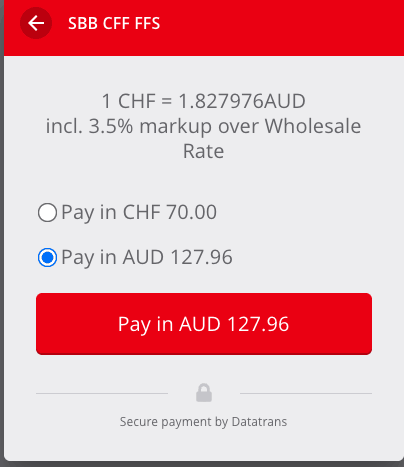

To SBB’s credit, it printed the markup on the screen. Most card machines don’t. You see a familiar dollar figure and no clue that the rate is worse.
What dynamic currency conversion is
Normally, when you pay in the local currency, your card network (Visa or Mastercard) converts it to AUD at close to the wholesale rate. With dynamic currency conversion (DCC), the shop’s payment company converts it at the till instead, at its own rate plus a margin. The shop usually gets a cut. You get to see dollars, which feels safer but costs more.
It’s legal, and you’re supposed to be offered the choice. But the screen is often set to AUD already, and staff may hand you the machine with “Australian dollars, yes?”
Where you’ll get asked
- Card machines in shops, restaurants and cafés, especially in tourist areas.
- ATMs. Look for “accept conversion?” or “with/without conversion”. Decline the conversion.
- Hotel checkout, where the bill is sometimes converted to AUD before you see it.
- Ticket machines and booking websites that show prices in AUD once they detect an Australian card, like the SBB screen above.
- Ski resorts. More on that below.
Skiing: where you have to pay attention
We ski at Saas-Grund in Switzerland, and it comes up all the time: lift passes, ski hire, mountain restaurants, the hotel. It’s a lot of card payments in a week, and each one is a chance to be charged in AUD.

If a ski week puts CHF 2,000 on your card and you let it go through in AUD at a 3.5% markup, that’s roughly A$120 gone. That’s lunch on the mountain for two, a couple of times over.
Watch out for being charged twice
Many Australian cards charge an international transaction fee (usually 3% to 3.5%) whenever the shop is overseas, even if you pay in AUD. So with DCC on one of those cards, you can pay the conversion markup and your bank’s fee. A card with no international fee, like the Ultimate or a Wise card, avoids the bank fee. It doesn’t protect you from DCC, though. You still have to choose local currency.
How to say no
- Look at the screen before you tap. If it shows AUD, press the local currency option.
- Say it out loud: “Local currency, please.” In Switzerland, “Francs, please.”
- If it has already gone through in AUD, ask them to cancel it and run it again in the local currency, before you sign or leave.
- If you weren’t given a choice, contact your bank about the charge.
Dynamic currency conversion: FAQs
What is dynamic currency conversion?
It’s when a shop, ATM or website overseas offers to charge you in Australian dollars instead of the local currency. The shop’s payment company sets the exchange rate and adds a markup, so you usually pay more than if your card converted it.
Should I pay in AUD or local currency overseas?
Local currency. On a CHF 70 Swiss train ticket, paying in AUD would have cost A$127.96. Paying in francs cost A$123.40 on my card.
Is dynamic currency conversion a scam?
No, it’s legal, and you’re supposed to be offered the choice. But it costs more, it’s often pre-selected, and few machines show the markup the way SBB did (3.5%).
Do ATMs overseas use dynamic currency conversion?
Many do. If the ATM offers to convert your withdrawal into AUD or asks you to “accept conversion”, decline it and take the local currency.
Does a no-fee travel card protect me from dynamic currency conversion?
No. A card with no international transaction fee avoids your bank’s fee, but if you accept payment in AUD, the merchant’s markup still applies. Choose local currency on every card.
What if I was charged in AUD by mistake?
Ask the shop to cancel the payment and run it again in the local currency, ideally before you leave. If you weren’t given the choice, talk to your bank.
Before you go, check what your cards really charge with the FX Rip-off Calculator.