
RACV Reciprocal Clubs: The Singapore Layover Hack

For years I assumed the private members’ club thing wasn’t for people like us. Old money, leather armchairs, a committee somewhere deciding you weren’t quite the type. Then I worked out you can buy your way into the global version of it for roughly the price of a decent dinner each month — and from the wrong state, which makes it cheaper still.
The trick is RACV reciprocal clubs. Join RACV as a country or interstate member rather than a Melburnian and you get the same 130-plus reciprocal clubs around the world for several hundred dollars a year less. We’ve used it to turn a brutal Singapore layover — the kind usually spent slumped over a Changi power point — into a morning by a 50-metre pool with the jet lag sweated out before the next flight.
Here’s exactly how it works, which of Singapore’s four clubs are worth the detour, and which aren’t.
The actual hack: RACV reciprocal clubs on an interstate membership
RACV Club has a few membership tiers. The Melbourne local ones make sense if you live there and want a base in the city. But every tier — local or not — carries the same line in the fine print: reciprocal access to 130-plus partner clubs in Australia and globally. That’s the bit that matters to a traveller.
Landing overseas? Sort your data first
An eSIM installs before you fly — no local SIM queue, no roaming bill.
Code: DREWDEAL (enter manually at checkout)
(Small referral our way if you use our link — doesn’t change your price.)
So you don’t need the expensive local membership. You need the cheapest one that still carries the reciprocal rights. For anyone outside Victoria, that’s the Country or Interstate tier.
Landing overseas? Sort your data before you go
An eSIM is a digital SIM you install on your phone before you fly — no swapping a physical card, no local SIM queue when you land, no roaming bill shock.
Airalo codes: DREWDEALNEW / DREWDEAL · Yesim code: DREWDEAL (enter manually at checkout)
Not sure which one? Compare Airalo vs Yesim →
(Small referral our way if you use our link — doesn’t change your price.)
| Membership | Cost | Reciprocal clubs? |
|---|---|---|
| Cheapest Melbourne resident pass | $99/month (~$1,188/yr) | Yes |
| Country or Interstate | $60/month ($720/yr) | Yes — same 130+ |
Same global access. About $468 a year less. The only thing you give up is the Melbourne-resident perks you were never going to use from interstate anyway.
How you actually get in the door
This is the part most people miss, and it’s why some travellers join and never use it. RACV reciprocal clubs don’t let you just rock up and flash the card — each one wants paperwork in advance.
You email the club before you travel with a letter of introduction from RACV and your travel itinerary. The letter sounds grand and old-fashioned, but it’s automated — you request it through the RACV site and it comes back without a human ever weighing your worthiness. Send that plus your dates, and the club confirms your visit.
The 12-hour layover, solved: Tanglin Club, Singapore
Singapore is where this really earns its keep. A long layover there is either a slow death by air-conditioning and overpriced laksa, or — if you’ve done the paperwork — a morning by a 50-metre pool with the jet lag sweated out of you before the next flight.
The Tanglin Club is our pick, every time. It sits just off Orchard Road, so it’s a short, cheap ride from either the airport or the city. The pool is the headline: proper lap lanes, loungers, a poolside bar, and enough shade that you’re not roasting. Arrive off an overnight flight, swim, shower, eat, lie down — and you walk back onto the next leg like a human being instead of a parcel.
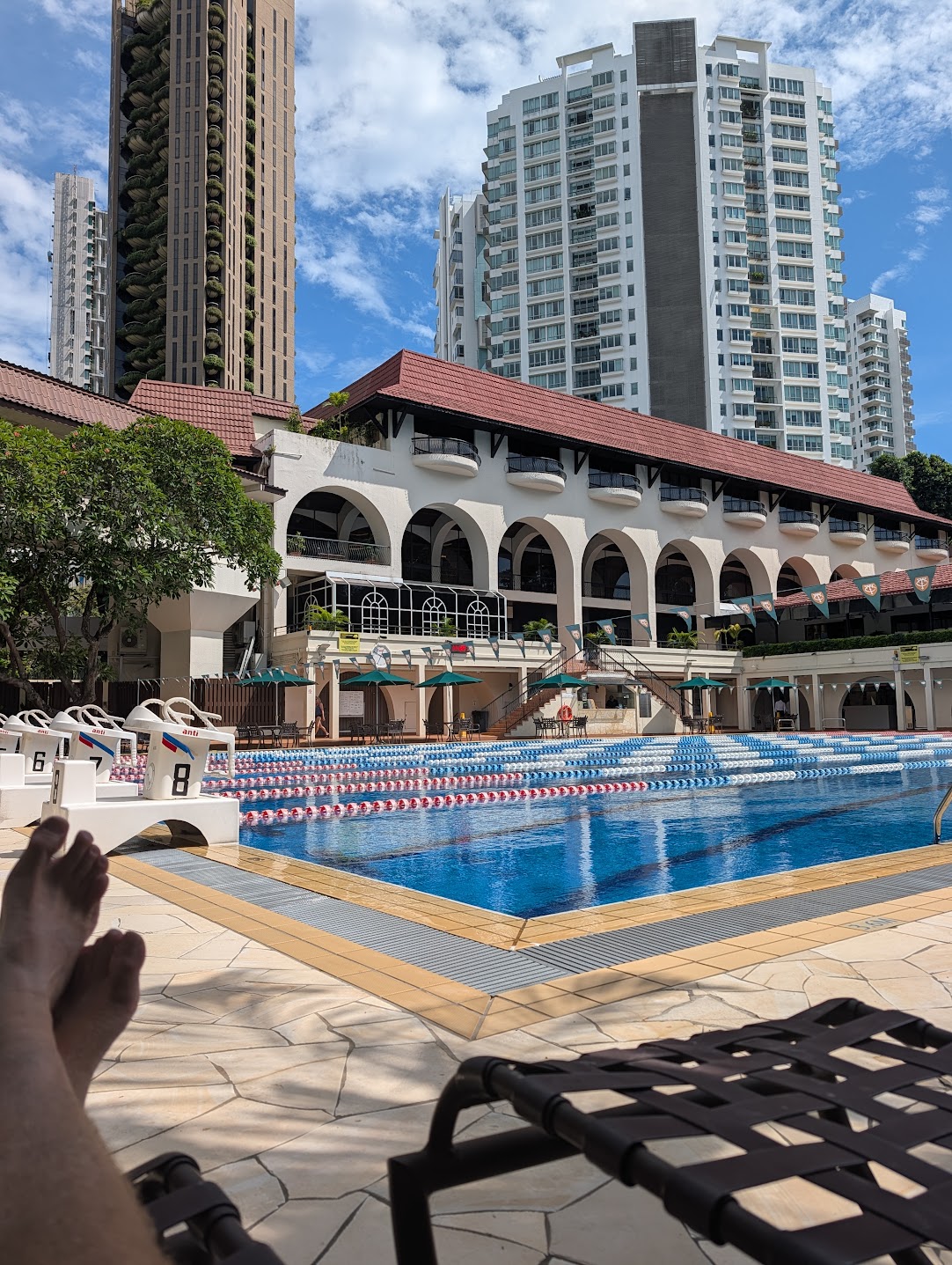
Getting between the four clubs was easy enough. We could have worked out how to get onto each club’s wifi, but it was less effort to just use our Airalo eSIM — we’d already had it running for the whole trip and used it on Google Maps to find each one.
The accommodation is genuinely good, too, which turns the layover hack into an overnight one. If you’ve got the time, book a room around the corner from Orchard Road for a fraction of what a comparable Singapore hotel costs, and you’ve got somewhere quiet to sleep off the flight before carrying on. If you’d rather stay on points, we’ve also reviewed the Holiday Inn Atrium in Singapore — and worked through whether buying IHG points actually stacks up before you do it.
Food-wise, the poolside restaurant — Wheelhouse — does the job nicely. Casual, good, fair value, with a menu that runs from satay sticks and ice kacang to the usual international plates. You can sit there in your swimmers with the pool in front of you, which is exactly what you want mid-layover.

The four Singapore clubs, ranked
Singapore has four clubs on the reciprocal network, and we’ve now been to all of them. They are not equal.
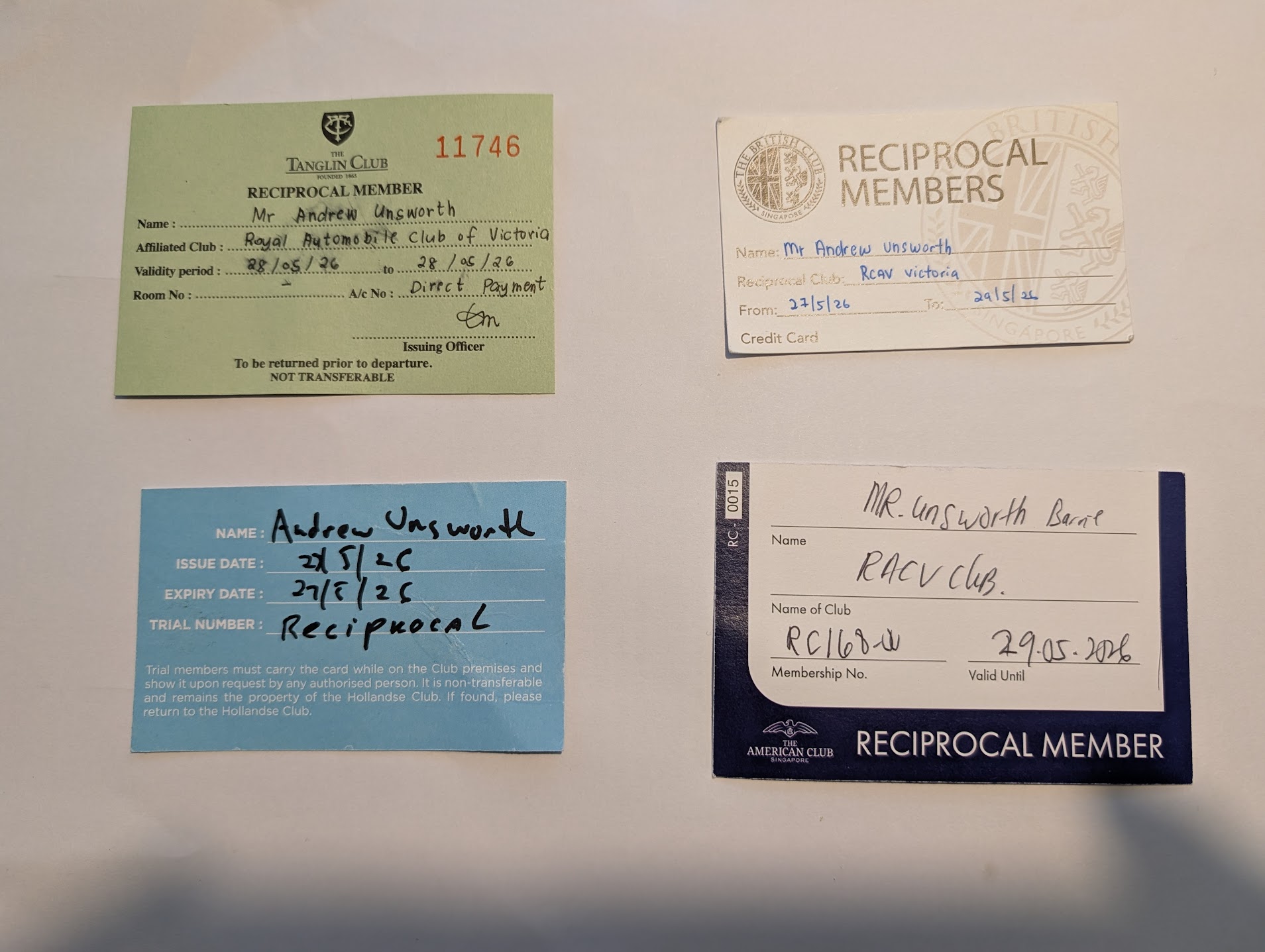
Tanglin Club — the best, as above. Central, brilliant pool, good rooms, easy to reach. If you only use one, use this.
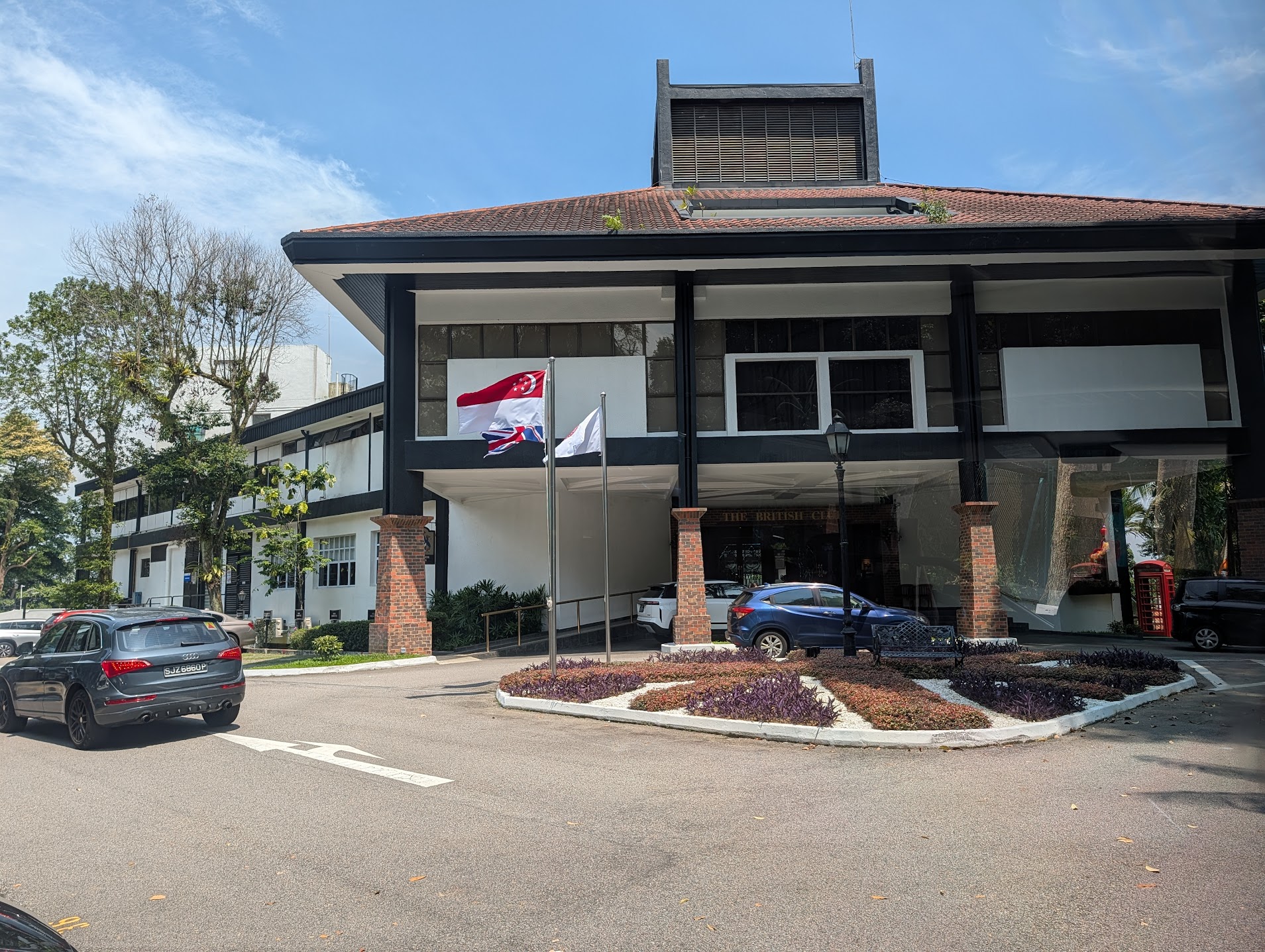
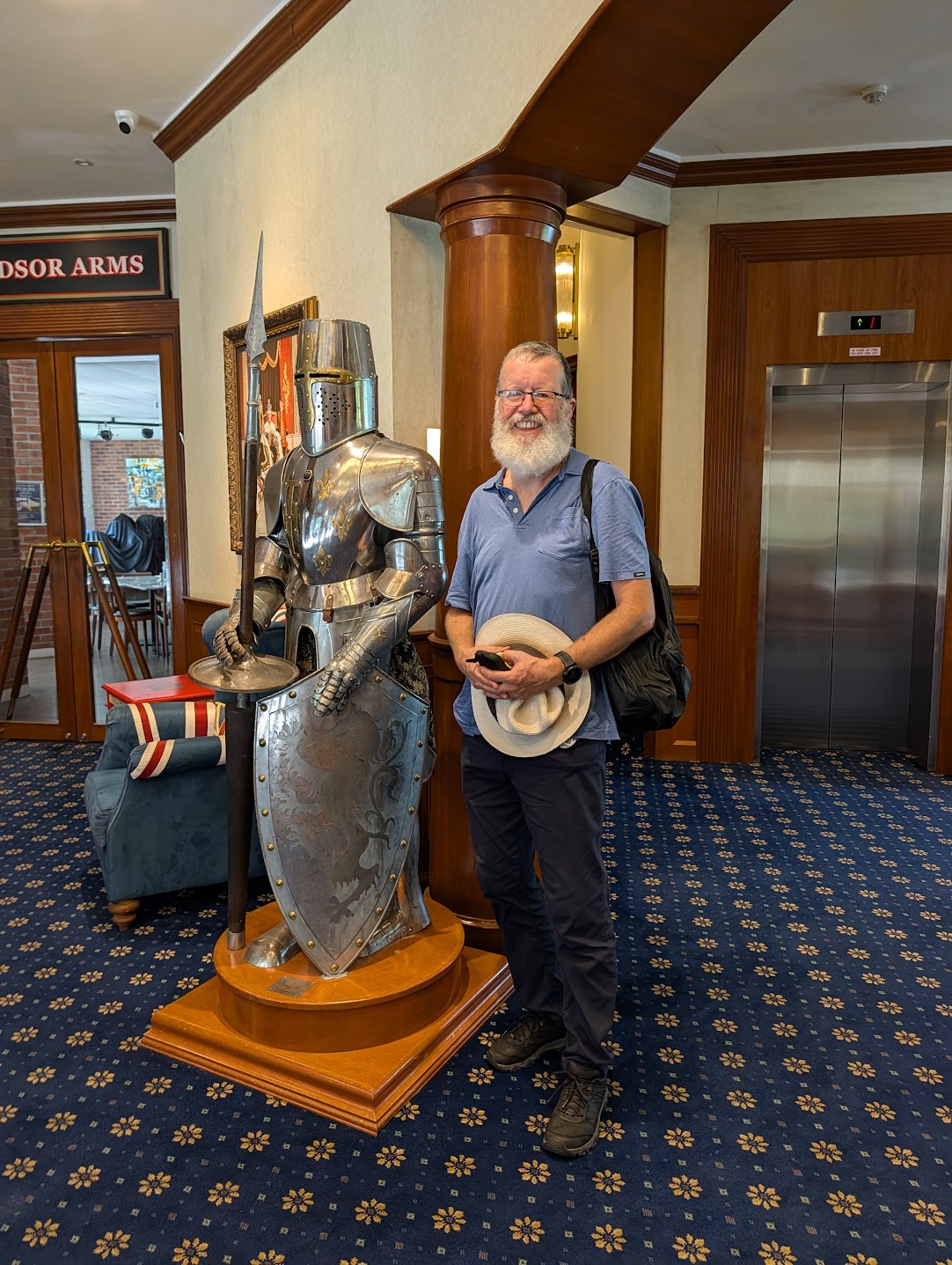
The British Club — the most characterful. It’s set up on a hill with a view back across the greenery to the city skyline, and the building leans into the theme: a red British telephone box out front, a full suit of armour standing guard in the lobby. There’s a regular shuttle bus down to the MRT, which solves the only real downside of being up a hill. Worth a visit for the setting alone.
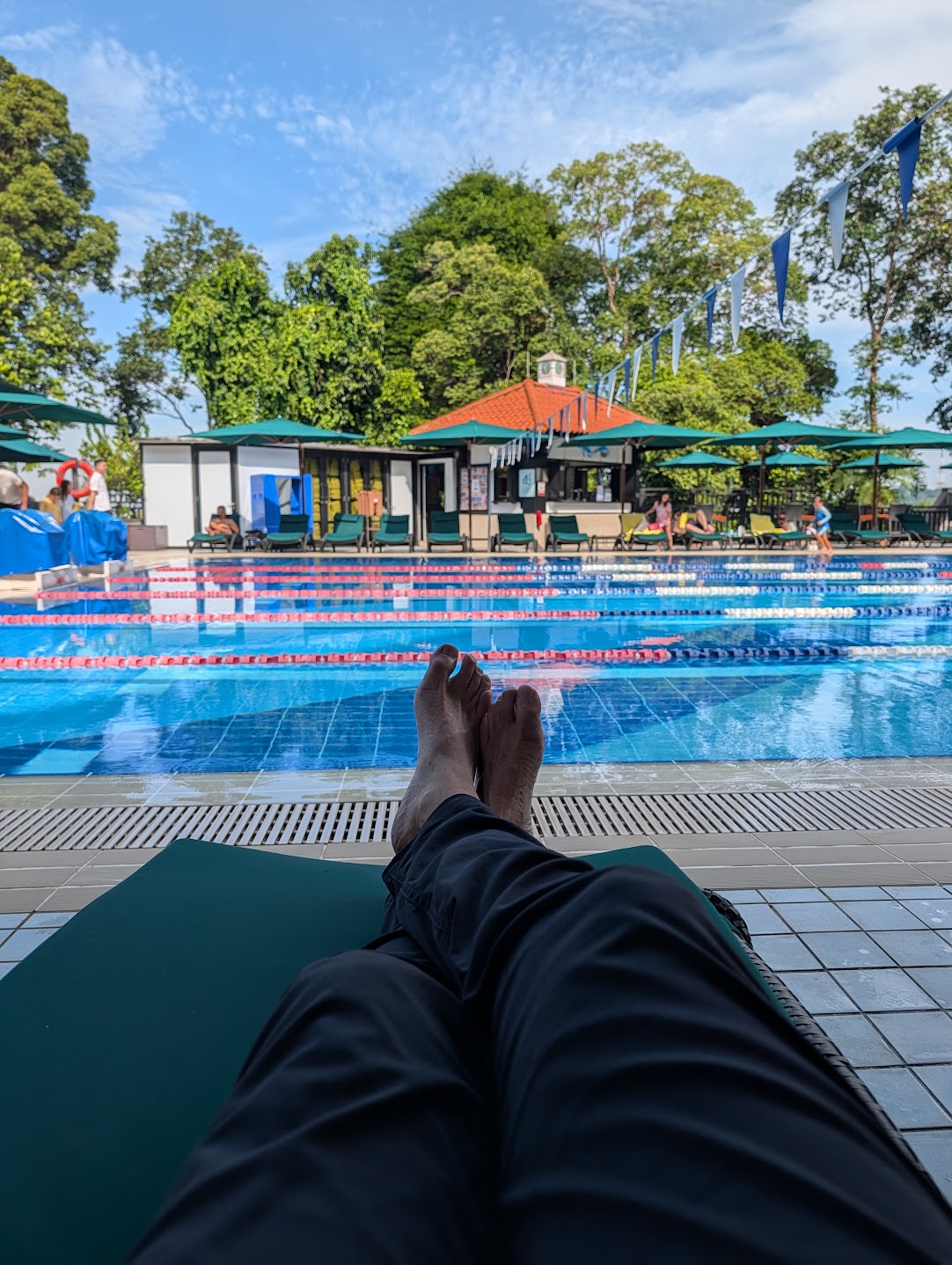
The American Club — exactly what you’d picture. A racquetball-and-swimming operation, well run and well equipped, but a bit soulless. Fine if it’s the one nearest you on the day; not one I’d cross town for.
Hollandse Club — the one to skip. A little run down, and the food came in slightly dearer than the others for no obvious reason. Pleasant enough, but it’s the bottom of the four for us.
Beyond Singapore
The same trick works wherever the network reaches. The UK in particular has a clutch of city clubs that suit a solo traveller well — somewhere safe and comfortable to eat alone, read, and sleep without paying hotel-bar prices for the privilege. Milton uses them constantly when he’s travelling on his own. Check the reciprocal list against your route and email ahead, same as Singapore.
And if you’re building a Singapore stopover around this, it pairs neatly with our 5 Singapore travel hacks you won’t find in guidebooks — the club layover is arguably the best of the lot, but the others are worth knowing.
Frequently asked questions
What are RACV reciprocal clubs?
RACV reciprocal clubs are the 130-plus partner clubs in Australia and around the world that an RACV Club membership gives you access to. You visit as a reciprocal member — you email ahead with a letter of introduction and your itinerary, and the club hosts you as if you were one of their own.
Do I have to live interstate to join the cheaper RACV tier?
The Country or Interstate tier is for members outside metropolitan Melbourne. If you live in Victoria’s metro area, you’d be looking at the local resident tiers instead. The reciprocal club access is the same across tiers — it’s the local Melbourne perks and the price that differ.
How much does interstate RACV Club membership cost?
The Country or Interstate tier runs at $60 a month, or $720 a year. The cheapest Melbourne resident pass is $99 a month, so you’re saving roughly $468 a year for the same 130-plus reciprocal clubs.
How do I get into a reciprocal club overseas?
Email the club before you travel with a letter of introduction from RACV and your travel itinerary. The letter is requested through the RACV site and is automated. The club then confirms your visit — do this several days ahead, not on the day.
Which Singapore club is best for a long layover?
The Tanglin Club. It’s just off Orchard Road, so it’s quick and cheap to reach from the airport, and the large lap pool, showers and dining make it ideal for resetting after an overnight flight. It also has good-value accommodation if you want to stay over.
Can I visit more than one reciprocal club on a trip?
Yes. As long as you’ve sent each club an introduction and itinerary in advance, you can use several on the same trip. Pick based on where you land and how much time you have.
Is the RACV reciprocal network worth it for occasional travellers?
Only if your routes pass through cities the network covers. The annual fee is fixed whether you use it twice or twenty times, so the value is all in how often you travel through covered cities. Check the reciprocal list against your typical itineraries before joining.

Planning this trip? Sort your data before you land
An eSIM is a digital SIM you install on your phone before you fly — no swapping a physical card, no local SIM queue when you land, no roaming bill shock.
Airalo covers 200+ destinations — up to 15% off with our link
Codes: DREWDEALNEW (new users) · DREWDEAL (existing users)
(Small referral our way if you use our link — doesn’t change your price.)
Landing overseas? Sort your data before you go
An eSIM is a digital SIM you install on your phone before you fly — no swapping a physical card, no local SIM queue when you land, no roaming bill shock.
Airalo codes: DREWDEALNEW / DREWDEAL · Yesim code: DREWDEAL (enter manually at checkout)
Not sure which one? Compare Airalo vs Yesim →
(Small referral our way if you use our link — doesn’t change your price.)