
Never Fight Over Exchange Rates or Split Bills Again

How to Stop Losing Money on Leftover Travel Cash (And Split Bills Without Ruining Friendships)
We’ve all been there. You’ve just landed back in Sydney or Melbourne after an epic trip to Japan, Europe, or the States. You’re jetlagged, you’re dreading going back to work, and sitting in your wallet is $300 worth of foreign currency you didn’t manage to spend at duty-free.
You have two choices:
- Put it in a drawer and tell yourself you’ll “use it next time” (spoiler: you won’t, and it will eventually become obsolete).
- Take it to the bank or a currency exchange booth, where they will happily buy it back from you—at a completely insulting exchange rate.
At the same time, you probably have a mate who is heading off on a trip next week and is about to get ripped off buying that exact same currency at the airport.
There has to be a better way, right? There is. It’s called cutting out the middleman.
The Problem: The “Spread” is Stealing Your Travel Funds
Banks and currency exchange booths make their money on the “spread”—the difference between the rate they buy currency for and the rate they sell it for.
If the real-world (mid-market) exchange rate for AUD to USD is 0.65:
- The booth will sell you USD at an effective rate of 0.61 (you pay more).
- The booth will buy back your leftover USD at a rate of 0.69 (they give you less).
They win coming and going, and you lose 5% to 10% of your money’s value just by holding the wrong colored paper.
Add to this the headache of group travel—trying to figure out who paid for the Airbnb, who bought the rounds of Bintangs, and how to settle up in a mix of AUD and foreign cash without someone feeling shortchanged.
The Solution: Peer-to-Peer Exchange
If you have leftover Euros, and your mate is going to Europe, you should just sell it to them. But at what rate? If you use the bank’s buy rate, your mate wins big. If you use the bank’s sell rate, you win big.
The fairest way is to use the mid-market rate (the real exchange rate you see on Google).
By trading at the mid-market rate:
- The Seller gets more AUD back than the bank would have given them.
- The Buyer pays less AUD than the airport exchange booth would have charged them.
- Everyone wins. (Except the banks, which is exactly how we like it).
Enter the Travel Cash Splitter (MatesFX)
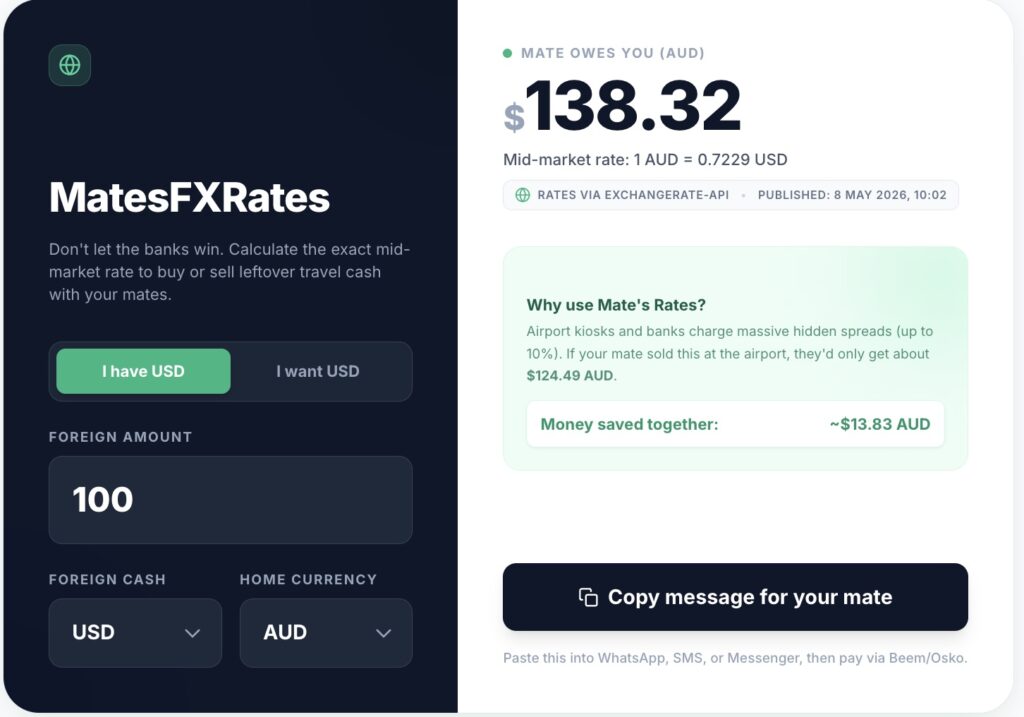
To make this completely frictionless, we built the Travel Cash Splitter (MatesFX).
No more arguing over calculators at the pub or dealing with complicated spreadsheets. We built this light, mobile-friendly app specifically to solve the group travel cash headache.
Here is how to use it:
- Enter the Currency: Select the foreign currency you are holding (e.g., JPY, USD, EUR) and the amount.
- Get the Real Rate: The tool instantly pulls the live mid-market exchange rate.
- See the “Win-Win” Split: It calculates exactly how much AUD should change hands so that both mates get a better deal than going to a bank.
- Split Group Expenses: If you’re currently on the trip, you can use it to evenly split a dinner bill or hotel cost in the local currency, converting it back to exactly what each person owes in AUD.
👉 Try the Free Travel Cash Splitter Here
Pro-Tip: Avoid the Cash Trap Altogether
While swapping leftover cash with mates is the smartest way to deal with physical notes, the ultimate points-hacker strategy is to minimize cash usage in the first place.
For 90% of your daily trip expenses, you should be using a card that offers Zero Foreign Transaction Fees while still earning reward points.
Our current favorite card for this is the CommBank Ultimate Awards which waives the standard 3% international fee.
Frequently Asked Questions
Do I really still need cash when travelling overseas in 2026? Yes. While tap-and-go is everywhere, you still need cash for tipping in the US, hawker centres in Singapore, small ryokans in Japan, or when the EFTPOS machine is “conveniently broken” in Bali. Take a small amount, but don’t overdo it.
What is the ‘mid-market rate’ and why should I care? It’s the real exchange rate—the one you see on Google or XE. Banks and airport booths use a much worse rate to make a hidden profit (the “spread”). The Cash Splitter uses the real mid-market rate so you and your mates split the difference, keeping the money away from the banks.
How much cash should I actually take? We recommend the equivalent of AUD $200–$500 for a standard trip. Put the rest of your spending on a Zero-FX travel card. The goal isn’t to carry huge amounts, just enough for daily incidentals.
Is MatesFX a bank? Does it transfer the money for us? No. MatesFX is simply a smart calculator that pulls live exchange rates. It does the complicated math to show exactly how much AUD you owe your mate (or they owe you). You still settle up via PayID or standard bank transfer like you normally would.
Can I use this for splitting dinner bills while overseas? Absolutely. If one mate pays a 15,000 Yen dinner bill in Tokyo, you can plug that into the Cash Splitter to instantly see exactly how much AUD everyone needs to Osko them back home. No guesswork involved.
Is it better to get cash at the airport or an overseas ATM? Never buy cash at the airport—it’s the biggest rip-off in travel. If you must get cash, use a card with zero international ATM fees at an ATM in your destination, or buy leftover cash from a mate using our calculator before you leave.
Bottom Line
Don’t let the banks double-dip on your hard-earned holiday funds. Next time you come home with a pocket full of Yen or Dollars, find a mate who is heading out, pull up the Cash Splitter, and keep the value in the Brotherhood.
Check out the riest of our Free Travel Tools here.
The Ultimate Travel Money Tool
Stop losing money to terrible airport exchange rates and hidden bank markups. Wise gives you local account details in multiple currencies so you can spend overseas at the true mid-market rate.
Get Your Global Account*If you use this link and make a qualifying transfer, we may earn a small commission at no extra cost to you.
More Travel & Points Tools
- FX Rip-Off Calculator: See exactly how much your bank is hiding in the exchange spread.
- Card Monkey: Optimize which card you use to get fee free FX.
- Why I Built Card Monkey: The story behind solving the rewards puzzle.