
Wise Card Australia Review 2026 – Why its in my Wallet

Australian banks pushed clunky, pre-loaded travel money cards for years. They were riddled with hidden load fees, terrible exchange spreads, and apps that were rubbish. it always surprised me that banks with all their capital could not have a better service.
Landing overseas? Sort your data first
An eSIM installs before you fly — no local SIM queue, no roaming bill.
Code: DREWDEALNEW (new users) · already have Airalo? Use DREWDEAL instead
(Small referral our way if you use our link — doesn’t change your price.)
I wrote this review for two reasons. My friend Alan waxed lyrical about his trip to Eastern Europe and Turkey and humble-bragged how much money he saved. Then another friend told me he was going to Europe with his high FX bank card. Heeding Alan’s words, I suggested a Wise card (and promptly shared a referral code!)
The Wise card solves the problem those legacy bank cards failed to address: making it genuinely easy to hold your money in dedicated currency “pots” for international travel. I’ve had Wise in my wallet for years as a core travel tool, but the way I use it is very specific.
If you’re heading overseas, here is a deep dive into why Wise is practically mandatory, how it protects your money, and why the math on using rewards credit cards abroad is broken.
In this post:
Low Friction, Not High Commitment
You don’t need to treat Wise like a primary bank account, and you don’t need to master every feature.
I don’t keep large balances sitting in Wise because I prefer to keep my cash in Australian high-interest savings accounts. Because my phone number and email are linked to my primary banking via PayID, I skip the PayID setup on Wise entirely. Instead, Wise gives you a dedicated BSB and Account Number. I just set it up as a standard payee in my main banking app and flick money across right before a trip.
It acts as a transit lounge for my travel cash, not a vault. And that specific strategy neatly addresses the biggest question Australians have about fintech apps: security.
How is Your Money Protected in Australia?
Most people assume any app that acts like a bank is a bank. In Australia, that distinction matters.
Wise is fully regulated, but it is not an Authorised Deposit-taking Institution (ADI). This means your money is not protected by the Australian Government Financial Claims Scheme (FCS), which guarantees consumer deposits up to $250,000 per account holder if an ADI collapses.
Why doesn’t Wise have it? Because Wise doesn’t lend your money out to other people to buy houses or cars like traditional banks do.
Instead, Wise protects your funds through a system called Safeguarding. By law, they keep customer money completely separate from their own business operational funds. Your money is held in cash, secure liquid assets like government bonds, or with reputable traditional banks.
Because there is no absolute sovereign government guarantee, my strategy is the textbook way to use the product: transfer your AUD over just before your trip, lock in the exchange rate for the local currency you need, and spend it. You aren’t leaving your life savings in the account, making the lack of an FCS guarantee a non-issue compared to the massive savings on fees.
The Big Bank Travel Fee Comparison
When you put Wise side-by-side with traditional and challenger banks, you see exactly why a dedicated travel card is still necessary.
| Provider & Debit Card | Foreign Transaction Fee (FX Fee) | International ATM Fee | Exchange Rate Used |
|---|---|---|---|
| Wise (Travel Card) | $0 (Small, transparent conversion fee upfront, usually ~0.4%) | Free up to $350 AUD/month (max 2 withdrawals), then $1.50 + 1.75% | Mid-Market Rate |
| CommBank (Smart Access) | 3.00% | $5.00 | Visa / Mastercard rate |
| Westpac (Choice) | 3.00% | $5.00 | Mastercard rate |
| NAB (Classic) | 3.00% | $5.00 | Visa rate |
| ANZ (Access Advantage) | 3.00% | $5.00 | Visa rate |
| St. George (Complete Freedom) | 3.00% | $5.00 | Visa rate |
| Macquarie Bank (Transaction) | 0% | $0 (Local ATM operator may charge) | Mastercard rate |
| UBank (Spend) | 0% | $0 (Local ATM operator may charge) | Visa rate |
| Bankwest (Platinum Debit) | 0% | $0 (Local ATM operator may charge) | Mastercard rate |
While challenger banks like Macquarie and UBank look great on paper, Wise offers three unique advantages:
- The “Lock It In” Advantage: With traditional cards, you are at the mercy of the live rate the exact second you tap your card overseas. With Wise, you can watch the rates and convert your AUD to a Euro or USD “Pot” when the rate is strong, locking in your travel budget.
- The Firewall Effect: If your card gets skimmed at a dodgy ATM, the damage is strictly limited to your travel pot, keeping your primary Australian salary and savings accounts completely safe.
- True Local Routing: Wise provides local account details (like a European IBAN), allowing you to pay international operators without $20+ telegraphic transfer fees.
The Real Cost: Putting Wise to the Test
Bank marketing only tells half the story. Banks love to shout about “zero fees” while quietly hiding their profit margins in a terrible exchange rate.
That is exactly why I built the FX Rip-off Calculator—a free tool that fetches the live mid-market rate and shows you exactly how much your bank is skimming off the top of every overseas purchase. (You can read the backstory of why I created it in Why I Built the FX Ripoff Calculator).
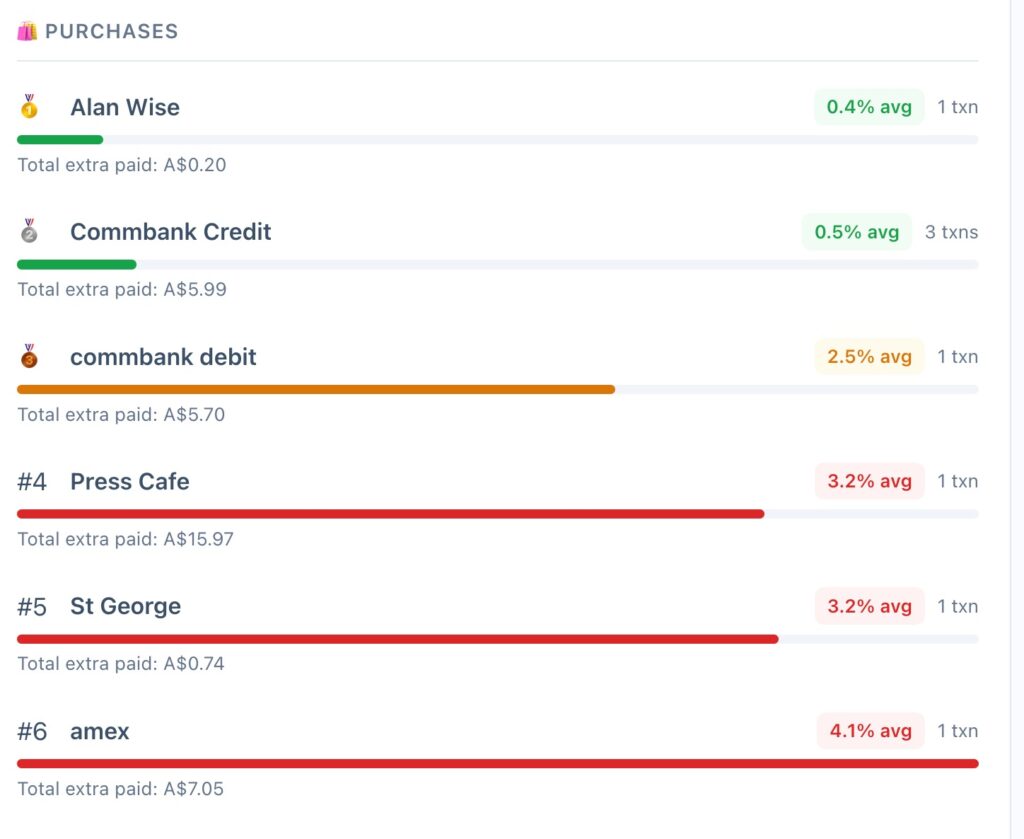
I ran a series of real transactions through the calculator, and the final rankings speak for themselves:
- The Winner: The Wise card (“Alan Wise”) took the gold medal, averaging a microscopic 0.4% markup over the true mid-market rate.
- The Acceptable: A premium card with no international transaction fees (CommBank Credit) came in a close second at 0.5%.
- The Rip-Off Zone: Standard cards get expensive quickly. CommBank Debit hit a 2.5% markup, St George hit 3.2%, and my Amex was the absolute worst, taking a massive 4.1% spread.
If your total overseas spend across a year is $10,000, using a 3% or 4% card costs you over $300 to $400 in hidden fees. Wise sits right at the absolute bottom of that cost curve.
The Points Trap: Why Using a Rewards Card Overseas is a Losing Game
Because this is Points Brotherhood, the natural instinct is to put every overseas dinner and hotel on a rewards credit card to rack up points.
But having spent years leading digital product teams across Australia’s major banks, I can tell you exactly how these fee structures are modeled. The margins on international spend are heavily engineered against you: the banks charge you more, and they give you fewer points.
For most peoples cards when you get hit with a 3% to 4% foreign transaction fee on a standard rewards card, you are effectively buying frequent flyer points at a massive premium. If you spend $1,000 abroad, you pay $30 in fees to earn perhaps 1,000 points. Those points are realistically worth about $15. You are mathematically losing money just to finance the bank’s profit margin.
Instead of chasing devalued points on an expensive credit card, it is infinitely better to use your own money via a highly optimized travel card.
Ready to stop paying the bank tax? Set up your Wise account for free, grab your BSB, and have the physical card ready in your wallet for your next trip—even if you don’t load your travel budget until you’re sitting in the airport lounge.
Frequently Asked Questions (FAQs)
Is my money safe with Wise in Australia?
Yes, but it is protected differently than a traditional bank account. Wise is not an Authorised Deposit-taking Institution (ADI), which means your funds are not covered by the Australian Government Financial Claims Scheme (FCS) that guarantees deposits up to $250,000. Instead, Wise uses a legally mandated system called Safeguarding. This means 100% of customer funds are kept entirely separate from Wise’s own business operational accounts and are held in secure assets or with Tier-1 traditional banks.
What are the ATM withdrawal limits and fees for the Wise card in Australia?
Australian Wise cardholders can withdraw up to $400 AUD equivalent per calendar month for free, with no limit on the number of withdrawals. If you withdraw more than $400 AUD in a single month, Wise charges a 2.69% variable fee on the amount above the free limit. Keep in mind that independent ATM operators overseas may still charge their own local usage fees.
How do I transfer money to my Wise card from an Australian bank?
You can easily top up your Wise account using PayID or a standard bank transfer. Wise provides you with a unique Australian BSB and Account Number. Simply log into your primary Australian banking app (like CommBank, Westpac, or Macquarie), set Wise up as a new payee, and transfer your desired travel funds across. The transfer is usually instantaneous.
Can I add my Wise card to Apple Pay or Google Wallet?
Yes. You can add your Wise travel card directly to Apple Pay, Google Wallet, and Garmin Pay. In fact, you can generate a digital card in the Wise app and add it to your mobile wallet immediately after signing up, allowing you to start spending overseas before the physical card even arrives in the mail.
Do I earn frequent flyer points when using the Wise card?
No, the Wise card is a debit/travel money card and does not earn Qantas or Velocity frequent flyer points. However, standard rewards credit cards typically charge a 3% to 4% foreign transaction fee. The cash you save by avoiding these exorbitant bank fees using Wise is generally worth far more than the value of the points you would have earned.
Spending overseas? Skip the card markup
Wise gives you the real exchange rate on a card built for spending abroad — no foreign transaction fee stacked on top
(Small referral our way if you use our link — doesn’t change your price.)